Stop the Content Grind: How SMEs Can Finally Scale B2B Content
Case Studies
•
James Roman

The result? Most SME teams don’t have a content problem. They have a content operations problem. The best b2b content marketing tools in the world won’t help if using them together feels like assembling furniture from six different brands with no shared instructions.
And this matters more now than it did two years ago. Because the alternative to organic content, paid acquisition, is getting more expensive by the quarter. Which raises an uncomfortable question: if your content engine is broken, what exactly is your long-term growth plan?
The ROI of Organic Growth
That question isn’t rhetorical. If content stalls, most SME founders default to the obvious fallback: spend more on ads.
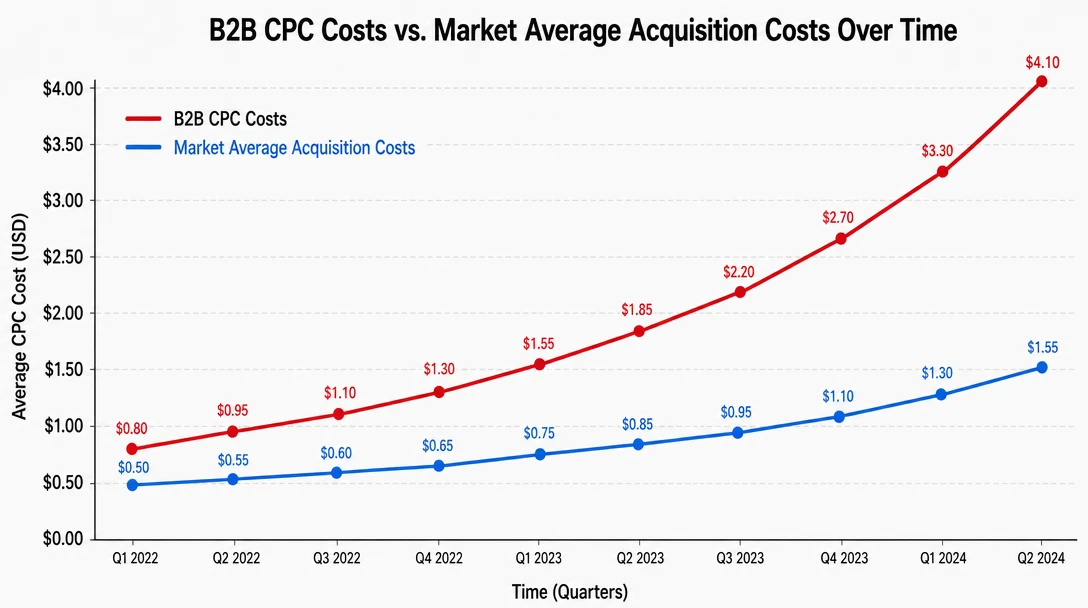
The problem is that paid acquisition keeps getting more expensive. B2B search CPCs have climbed steadily over the past two years, and every competitor bidding on the same keywords pushes your cost per lead higher. The math only gets worse at scale. Double your ad budget and you might double your traffic, but the moment you stop spending, the traffic vanishes.
Organic content works on the opposite principle.
Paid traffic is rented.
You pay for every click, every impression, every visit. Stop paying, stop getting.
Organic traffic compounds.
A well-structured blog post published today can generate leads for months or years without additional spend.
Content builds equity.
Each piece strengthens your domain, earns backlinks, and creates entry points for new audiences. Ads build nothing permanent.
Cost per lead drops over time.
Your 50th article doesn’t cost more than your 5th, but the cumulative SEO authority makes every new piece more effective.
For SMEs running a small business content strategy on a tight budget, this distinction is critical. You can’t outspend enterprise competitors on Google Ads. But you can outpublish them if your production cost per piece is low enough and your workflow is fast enough.
That’s the real advantage of content marketing automation tools: not just saving time, but making organic growth economically viable for teams that don’t have a dedicated content department.
The catch, of course, is that none of this compounds if you can’t actually ship . A content strategy that produces two posts a quarter isn’t compounding. It’s stalling.
Which brings us to the core question: what would change if publishing were the easy part?
Stop Managing, Start Publishing with Bloggerly
That’s exactly what Bloggerly is built to do: make publishing the easy part.
Not “easier.” Not “slightly less painful.” The easy part. The thing you stop thinking about so you can focus on what actually requires your brain: your product, your customers, your positioning.
Here’s the difference. The fragmented stack you’re used to looks something like this:
Research
in one tab (Google Scholar, competitor blogs, industry reports)
Draft
in another (ChatGPT, Jasper, or a blank Google Doc you stare at)
SEO checks
in a third (Surfer, Clearscope, Yoast)
Images
in a fourth (Canva, Midjourney, stock photo sites)
Publishing
in a fifth (WordPress, Webflow, Ghost)
Repurposing
if you somehow still have energy (Buffer, LinkedIn, newsletters)
Each tool has its own login, its own learning curve, its own subscription. You’re the glue holding all of it together, copying and pasting between windows, reformatting, second-guessing whether your structure is right. Three hours later, maybe you have a draft. Maybe.
Bloggerly replaces that entire chain with a single pipeline:
Research → Write → Cite → SEO Structure → Image Placement → Publish → Repurpose
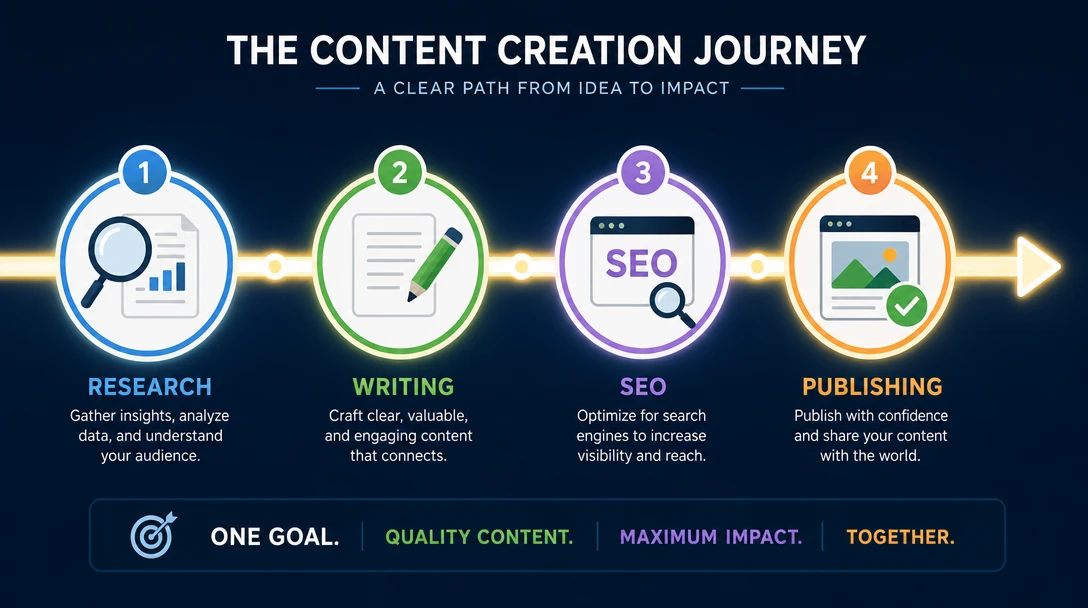
You bring the topic. You make the editorial calls. The system handles the production logistics, from pulling relevant sources and generating cited content to structuring headings for search performance and placing images where they belong. No prompt engineering. No toggling between six browser tabs. No reformatting for WordPress at 11 PM.
This isn’t another AI writing tool that hands you a blob of text and wishes you luck. Bloggerly is a publishing pipeline. The distinction matters. AI tools for content marketing can generate words. A pipeline gets those words researched, structured, illustrated, optimized, and live on your site, without you managing every handoff.
For SME founders who’ve been stuck in the “start three posts, publish zero” cycle, the shift feels dramatic. The bottleneck was never your ideas or your expertise. It was the operational overhead between having something to say and actually saying it in public.
Remove that overhead, and the compounding math from the previous section actually starts working. You publish weekly instead of quarterly. Your domain authority grows. Your cost per lead drops.
But knowing the workflow is faster doesn’t answer the obvious next question: what does this actually cost compared to the alternatives?
The Pipeline vs. The Hire: The Financial Reality
Let’s do the honest math.
Option A: Fractional content hire
Cost:
$3,500/month for a decent freelance content marketer or fractional hire
Output:
4–8 posts per month (if they’re fast and you’re not stuck in revision loops)
Hidden costs:
Onboarding time, editorial oversight from you, style guide creation, SEO briefing, image sourcing they’ll ask you to handle anyway
Risk:
They get a better client, take a vacation, or quietly deprioritize your account. Your publishing calendar goes dark.
Option B: Automated content pipeline at $39/month
Output:
As many posts as your editorial calendar demands
Hidden costs:
Your time making editorial decisions (which you’d spend regardless)
Risk:
None of the human reliability problems. The system doesn’t ghost you before a product launch.
The gap isn’t subtle. You’re comparing roughly $42,000 a year against under $500. Even if you factor in the time you spend directing the pipeline, the per-post economics aren’t close.
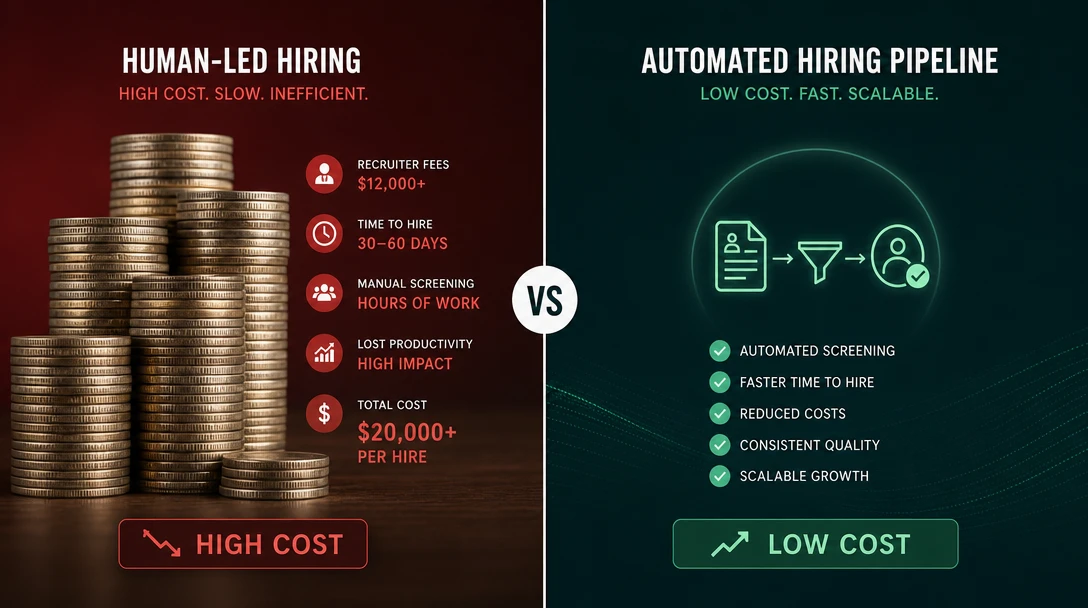
And here’s what the spreadsheet misses: consistency matters more than quality ceilings. A fractional hire might write a slightly better individual post. But if they produce four articles in a good month and zero in a bad one, your organic growth stalls. Search engines reward sites that publish regularly. A pipeline that helps you ship every single week will outperform a brilliant writer who delivers sporadically.
This isn’t an argument against hiring writers forever. When your content operation is generating enough organic revenue to justify a team, hire one. But if you’re an SME founder trying to get from zero to traction, spending $3,000 a month before you’ve validated that content works for your business is a bet you don’t need to make.
The smarter move: prove the channel with a low-cost, high-reliability system first. Scale the team later, with data.
Content compounds, but only if you actually publish. Every week you spend juggling five apps and finishing zero posts is a week your competitors are building organic equity you’ll have to pay to catch up with later. The tool stack isn’t helping you. It’s the bottleneck.
Bloggerly’s Beta is open now.
One pipeline. Research, writing, citations, SEO structure, images, publishing. Stop managing the grind and start building the asset. Your future traffic is waiting on the other side of your first consistent month.
You sit down on a Monday morning, coffee in hand, ready to finally write that blog post. You open Notion for your outline. Then ChatGPT for a draft. Then a new tab for source-checking. Another for SEO keywords. Canva for the header image. WordPress to format and publish. Two hours later, you’ve toggled between twelve browser tabs, reformatted the same paragraph three times, and published exactly nothing.
This is the reality for most SME founders trying to run a small business content strategy. The dirty secret? Your content isn’t stalling because you can’t write. It’s stalling because your workflow is a graveyard of disconnected apps, each one demanding its own login, its own learning curve, and its own slice of your morning. The problem was never talent. It’s the tool stack. And until you replace that pile of apps with a single automated pipeline, every “content plan” you make will follow the same pattern: ambitious on Monday, abandoned by Wednesday.
The lost ‘Content Plan’
Every SME founder has a graveyard of Google Docs titled things like “Q3 Content Calendar” or “Blog Ideas - FINAL.” The plans are never the problem. The execution is.
Here’s what actually happens. You carve out two hours on a Thursday afternoon to write. You open your outline tool, your AI drafting tool, your keyword checker, your image generator, and your CMS. Before you type a single publishable sentence, you’ve spent 30 minutes just setting up to write. Then Slack pings. A client calls. The window closes. The draft sits at 40% forever.
This is the tool stack disaster, and it kills more content than writer’s block ever has.
The real bottleneck isn’t creative. It’s logistical:
Context switching
between five or six apps drains focus before you even start producing
No single source of truth
means outlines live in one place, drafts in another, images in a third
Each tool requires its own expertise.
SEO plugins work differently from AI writers, which work differently from your CMS
Nothing connects.
You’re the integration layer, manually copying, pasting, reformatting, and re-uploading across every step
Quality control falls apart
when you’re exhausted from the process before you even proofread
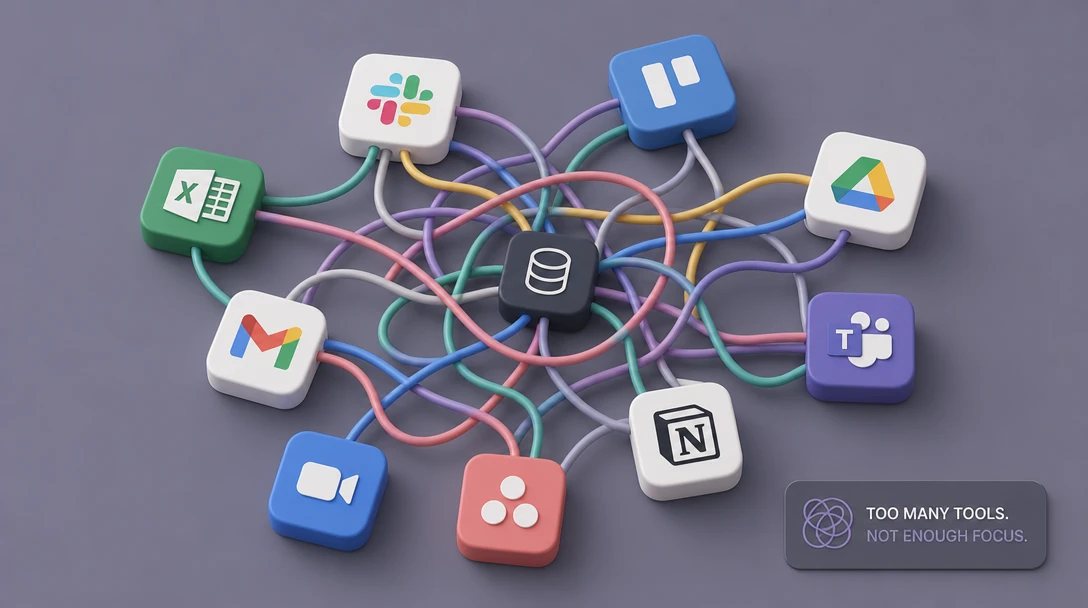
The result? Most SME teams don’t have a content problem. They have a content operations problem. The best b2b content marketing tools in the world won’t help if using them together feels like assembling furniture from six different brands with no shared instructions.
And this matters more now than it did two years ago. Because the alternative to organic content, paid acquisition, is getting more expensive by the quarter. Which raises an uncomfortable question: if your content engine is broken, what exactly is your long-term growth plan?
The ROI of Organic Growth
That question isn’t rhetorical. If content stalls, most SME founders default to the obvious fallback: spend more on ads.
The problem is that paid acquisition keeps getting more expensive. B2B search CPCs have climbed steadily over the past two years, and every competitor bidding on the same keywords pushes your cost per lead higher. The math only gets worse at scale. Double your ad budget and you might double your traffic, but the moment you stop spending, the traffic vanishes.
Organic content works on the opposite principle.
Paid traffic is rented.
You pay for every click, every impression, every visit. Stop paying, stop getting.
Organic traffic compounds.
A well-structured blog post published today can generate leads for months or years without additional spend.
Content builds equity.
Each piece strengthens your domain, earns backlinks, and creates entry points for new audiences. Ads build nothing permanent.
Cost per lead drops over time.
Your 50th article doesn’t cost more than your 5th, but the cumulative SEO authority makes every new piece more effective.
For SMEs running a small business content strategy on a tight budget, this distinction is critical. You can’t outspend enterprise competitors on Google Ads. But you can outpublish them if your production cost per piece is low enough and your workflow is fast enough.
That’s the real advantage of content marketing automation tools: not just saving time, but making organic growth economically viable for teams that don’t have a dedicated content department.
The catch, of course, is that none of this compounds if you can’t actually ship . A content strategy that produces two posts a quarter isn’t compounding. It’s stalling.
Which brings us to the core question: what would change if publishing were the easy part?
Stop Managing, Start Publishing with Bloggerly
That’s exactly what Bloggerly is built to do: make publishing the easy part.
Not “easier.” Not “slightly less painful.” The easy part. The thing you stop thinking about so you can focus on what actually requires your brain: your product, your customers, your positioning.
Here’s the difference. The fragmented stack you’re used to looks something like this:
Research
in one tab (Google Scholar, competitor blogs, industry reports)
Draft
in another (ChatGPT, Jasper, or a blank Google Doc you stare at)
SEO checks
in a third (Surfer, Clearscope, Yoast)
Images
in a fourth (Canva, Midjourney, stock photo sites)
Publishing
in a fifth (WordPress, Webflow, Ghost)
Repurposing
if you somehow still have energy (Buffer, LinkedIn, newsletters)
Each tool has its own login, its own learning curve, its own subscription. You’re the glue holding all of it together, copying and pasting between windows, reformatting, second-guessing whether your structure is right. Three hours later, maybe you have a draft. Maybe.
Bloggerly replaces that entire chain with a single pipeline:
Research → Write → Cite → SEO Structure → Image Placement → Publish → Repurpose
You bring the topic. You make the editorial calls. The system handles the production logistics, from pulling relevant sources and generating cited content to structuring headings for search performance and placing images where they belong. No prompt engineering. No toggling between six browser tabs. No reformatting for WordPress at 11 PM.
This isn’t another AI writing tool that hands you a blob of text and wishes you luck. Bloggerly is a publishing pipeline. The distinction matters. AI tools for content marketing can generate words. A pipeline gets those words researched, structured, illustrated, optimized, and live on your site, without you managing every handoff.
For SME founders who’ve been stuck in the “start three posts, publish zero” cycle, the shift feels dramatic. The bottleneck was never your ideas or your expertise. It was the operational overhead between having something to say and actually saying it in public.
Remove that overhead, and the compounding math from the previous section actually starts working. You publish weekly instead of quarterly. Your domain authority grows. Your cost per lead drops.
But knowing the workflow is faster doesn’t answer the obvious next question: what does this actually cost compared to the alternatives?
The Pipeline vs. The Hire: The Financial Reality
Let’s do the honest math.
Option A: Fractional content hire
Cost:
$3,500/month for a decent freelance content marketer or fractional hire
Output:
4–8 posts per month (if they’re fast and you’re not stuck in revision loops)
Hidden costs:
Onboarding time, editorial oversight from you, style guide creation, SEO briefing, image sourcing they’ll ask you to handle anyway
Risk:
They get a better client, take a vacation, or quietly deprioritize your account. Your publishing calendar goes dark.
Option B: Automated content pipeline at $39/month
Output:
As many posts as your editorial calendar demands
Hidden costs:
Your time making editorial decisions (which you’d spend regardless)
Risk:
None of the human reliability problems. The system doesn’t ghost you before a product launch.
The gap isn’t subtle. You’re comparing roughly $42,000 a year against under $500. Even if you factor in the time you spend directing the pipeline, the per-post economics aren’t close.
And here’s what the spreadsheet misses: consistency matters more than quality ceilings. A fractional hire might write a slightly better individual post. But if they produce four articles in a good month and zero in a bad one, your organic growth stalls. Search engines reward sites that publish regularly. A pipeline that helps you ship every single week will outperform a brilliant writer who delivers sporadically.
This isn’t an argument against hiring writers forever. When your content operation is generating enough organic revenue to justify a team, hire one. But if you’re an SME founder trying to get from zero to traction, spending $3,000 a month before you’ve validated that content works for your business is a bet you don’t need to make.
The smarter move: prove the channel with a low-cost, high-reliability system first. Scale the team later, with data.
Content compounds, but only if you actually publish. Every week you spend juggling five apps and finishing zero posts is a week your competitors are building organic equity you’ll have to pay to catch up with later. The tool stack isn’t helping you. It’s the bottleneck.
Bloggerly’s Beta is open now.
One pipeline. Research, writing, citations, SEO structure, images, publishing. Stop managing the grind and start building the asset. Your future traffic is waiting on the other side of your first consistent month.